The Plastic Bag Princess: Adaptation vs Mitigation in an Evolving Society
Weighing adaptation versus mitigation strategies for climate action through the lens of Canada's plastic bag ban.
Also on LinkedIn
The Plastic Bag Princess:
Adaptation vs Mitigation in an Evolving Society
Written by Claire Patterson
For something to be truly sustainable, it should mitigate its impact on the environment, economy, and society. Scientists and engineers often hold the environment at the forefront, upsetting the fragile balance that allows for proper adoption of the new practice or technology.
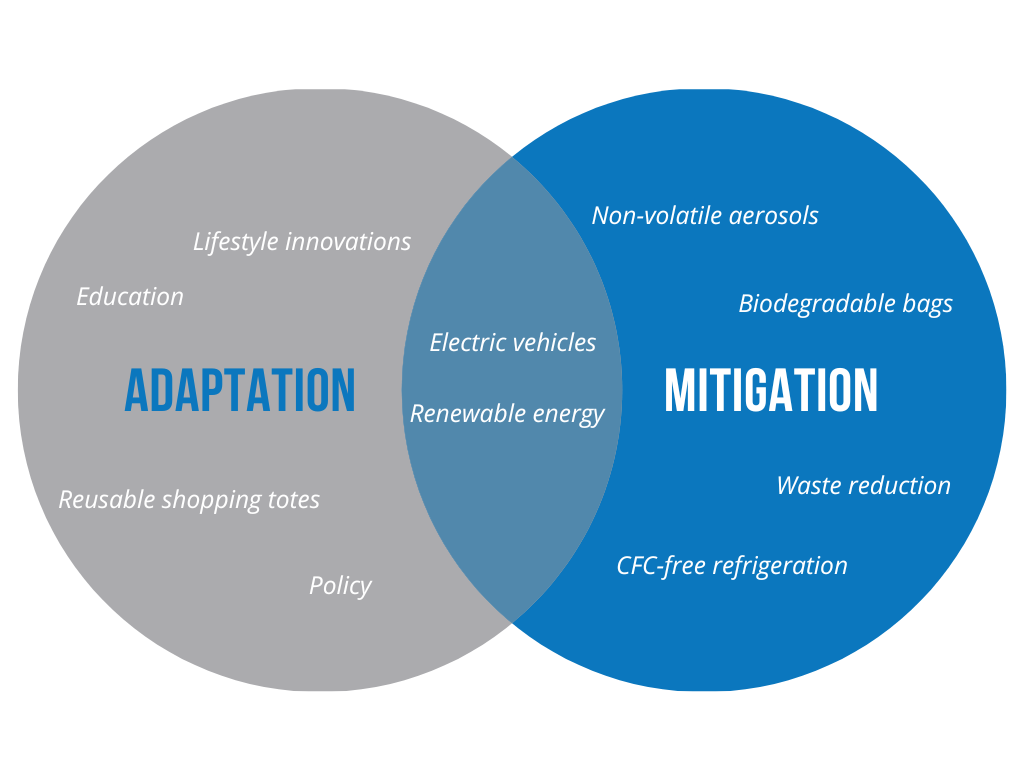
Humans are creatures of habit: we do not respond well to change, and less so if the change requires additional effort or time. Climate change solutions take one of two avenues: adaptation or mitigation. Adaptation solutions are developed in response to an event. You can either adapt your lifestyle or the technology to the changing times and circumstances. Mitigation, however, reduces the impact that the current standard is causing. It doesn’t wholly eliminate anything from society; its impact on the user’s lifestyle is minimal, while having a large impact on the environment.
Mitigation - reducing climate change.
Adaptation - adapting to life in a changing climate. 1
Let’s use the example of plastic bags. Canadian Federal legislation phased out plastic bags from grocery stores in December 2023. Most companies opted for the reusable bag alternative, meaning Canadians had to now either remember to bring the bags into the stores or buy new ones: no longer free like their plastic counterparts. Grocery stores nowadays sell non-woven polypropylene bags at their tills for $0.50 to $3.00. Their production costs are approximately double that of a conventional plastic bag, and their end-of-life situation is indifferent to whether the bags were made of virgin or recycled materials. They will become landfill. At the end of the day, the bags are still synthetic plastic: studies have found the bags should be used between 11 and 28 times to offset their added ecological costs. 2
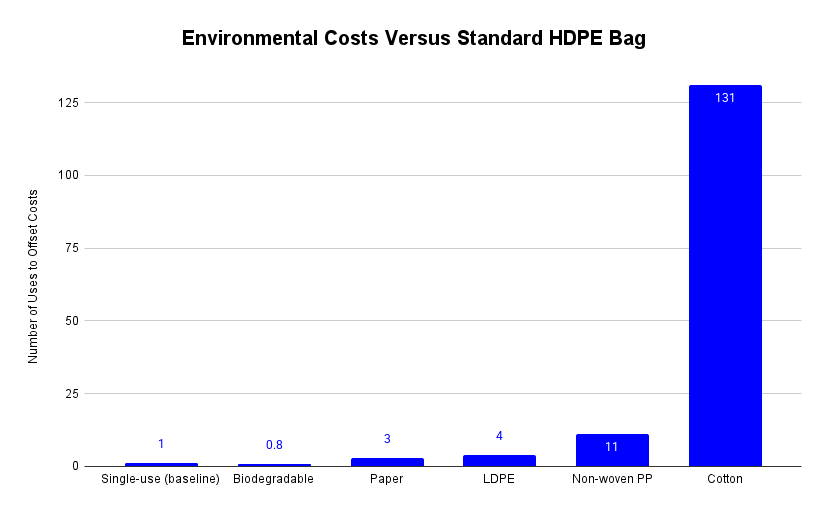
Comparing the number of uses required to offset the added environmental production costs (water, pesticide, carbon release, etc.) versus a standard HDPE plastic bag. Source
In comparison to the single-use plastic bag, reusables still offer more benefits. In fact, many municipalities have now started to accept them through their recycling program or by donation to food banks.
From a corporate standpoint, canvas, cotton, and other organic materials are too costly to mass produce. Cotton is also extremely pesticide-intensive; since 2023, shoppers have had to adapt their lifestyle to conform to the new legislation. Arguably, the economic and lifestyle tradeoffs have yet to overwhelmingly pay off for the environmental benefits.
Mitigation can also come in the form of reverting to the past to move forward. Prior to the commercialization of plastic bags in the 1980s, shoppers would often tote their items home in paper bags. Paper is biodegradable and easy to recycle or compost, though their high rate of use outweighs its rate of renewability. Manufacturers often opt for new material, with longer and stronger fibres. The product’s short lifespan does not make it the best plastic alternative.
The paper’s recyclability is also limited by any contamination or moisture in the paper. Companies will use cheap barrier materials like polyethylene or polypropylene to line the material to make the natural paper mre hydrophobic. Thus, paper cups and containers cannot be recycled due to the mixed materials and use of petroleum-based plastics. The paper cup may look appealing, but at end-of-life, it is seldom better than the styrofoam option.
In a rapidly evolving society, optimally, mitigation is twofold: taking inspiration from nature and past habits, to update the modern user’s product. Oligomaster sets the stage for sustainable product development to bring new technologies to the market. We have already successfully brought biodegradable bags from lab to market, being involved throughout the development, manufacturing, and commercialization process.
Little adaptation is required. By replacing standard polypropylene bags, shoppers could carry their groceries home in biodegradable bags and cast them aside. Here, the impact to their lifestyle is minimal: users don’t have to remember to bring bags into the shops, pay at the register for more if they forget, and they don’t amass in their homes. Like their plastic bag cousins, biodegradable bags are easily cleaned and are encouraged to be reused in household applications as waste bin liners or pet waste collectors. The sole difference is now the bags can be placed in municipal green bins instead of the trash can for better end-of-life scenarios.
Sustainability comes into play through a product’s entire lifecycle: from its manufacturing to its end of life via recycling or biodegradation.
Extracting beyond the example of plastic grocery bags, adaptation solutions often risk becoming obsolete as society refuses to adopt the change. These solutions are typically gradual and step-wise, requiring a longer period of acceptance to avoid the environmental/social/economic balance being impacted too quickly. Electric vehicles were introduced slowly, incentivized by tax refunds, municipalities installing EV charging stations in large public areas, and years of iteration. The rapid adoption of these vehicles was largely halted by the high purchase price and the reluctance of large petroleum companies to accept losing their primary revenue sources. Petro Canada is already seeing the impact on its profits, reporting net earnings of $818 million in the fourth quarter of 2024, in comparison to 2023’s fourth quarter of 2.82 billion, a 3.5x decrease.
Mitigation technologies do not significantly impact the average person’s life, so they largely go undiscussed by the media. Chlorofluorocarbons (CFCs) are attributed to being the primary culprit for holes in the ozone layer. Search on any mainstream news platform, and you will be hard-pressed to find an article written about them in the past decade. Chemical companies found new ways to deliver a similar product without this compound. Hairspray still holds, fridges still run, all with little change needed by the daily consumer. In 2016, an MIT professor of Environmental Studies, Suzan Solomon, noted the ozone hole over the Antarctic was reportedly shrinking with each year. Then in 2018, scientists could say with 95% confidence that ozone recovery was in direct correlation to human efforts in reducing ozone-depleting substances. 3
Solving the single-use plastics problem is by no means one-size-fits-all. All consumers, stakeholders, retailers, and manufacturers need to work in tandem to develop a solution. Adaptation and mitigation should go hand-in-hand to approach climate change.
Living in a society means agreeing to be mutually part of the solution. Adapting your lifestyle and adapting technologies ultimately mitigates impacts. Oligomaster is helping with climate mitigation by reducing impact on the environment and consumers’ lives. We are actively helping in the adaptation sector by helping to move the needle on new innovation adoption. We work to reduce greenhouse gas emissions, without reducing quality of life.