Connecting to Canadians: Reflecting on INC-4 and the Path to a Circular Economy
A look at INC-4, Canada's Federal Plastics Registry, and the path toward a global plastics treaty and circular economy.
Also on LinkedIn
Connecting to Canadians:
Reflecting on INC-4 and the Path to a Circular Economy
Written by Claire Patterson
The fourth meeting of the International Negotiating Committee (INC-4) was held in Ottawa six months ago from April 23-29th. 175 countries met to initiate, prepare, and develop international and legally binding instruments to manage plastic pollution, with the goal of a global agreement by the end of 2024. Parties representing many factions of the plastics industry attended, sharing their perspectives and how they will be impacted by the Committee’s outcomes. Contributors include business representatives, academics, subnational governments, and financialists. Youths, Indigenous peoples, and members of civil society were also invited to participate. Read the full report of the INC on the work of its fourth session.
This has been in tandem with the UN’s ambitious, yet effective global agreement to end plastic pollution by 2040. The High Ambition Coalition to End Plastic Pollution (HAC) is the driving parent program behind the INC treaty negotiations and has set the common goal to end plastic pollution by 2040.
Source
Intersessional work has been happening between INCs four and five.
Two expert groups have been recruited. The first focuses on developing a method to analyze criteria and non-criteria-based approaches to evaluate a plastic product’s recyclability and reusability based on its uses and applications. The second is analyzing potential sources to establish, align, and catalyze the financial mechanisms associated with this initiative. Reconvening at INC-5, the two groups will create a way forward for circular economies to thrive in the new policy.
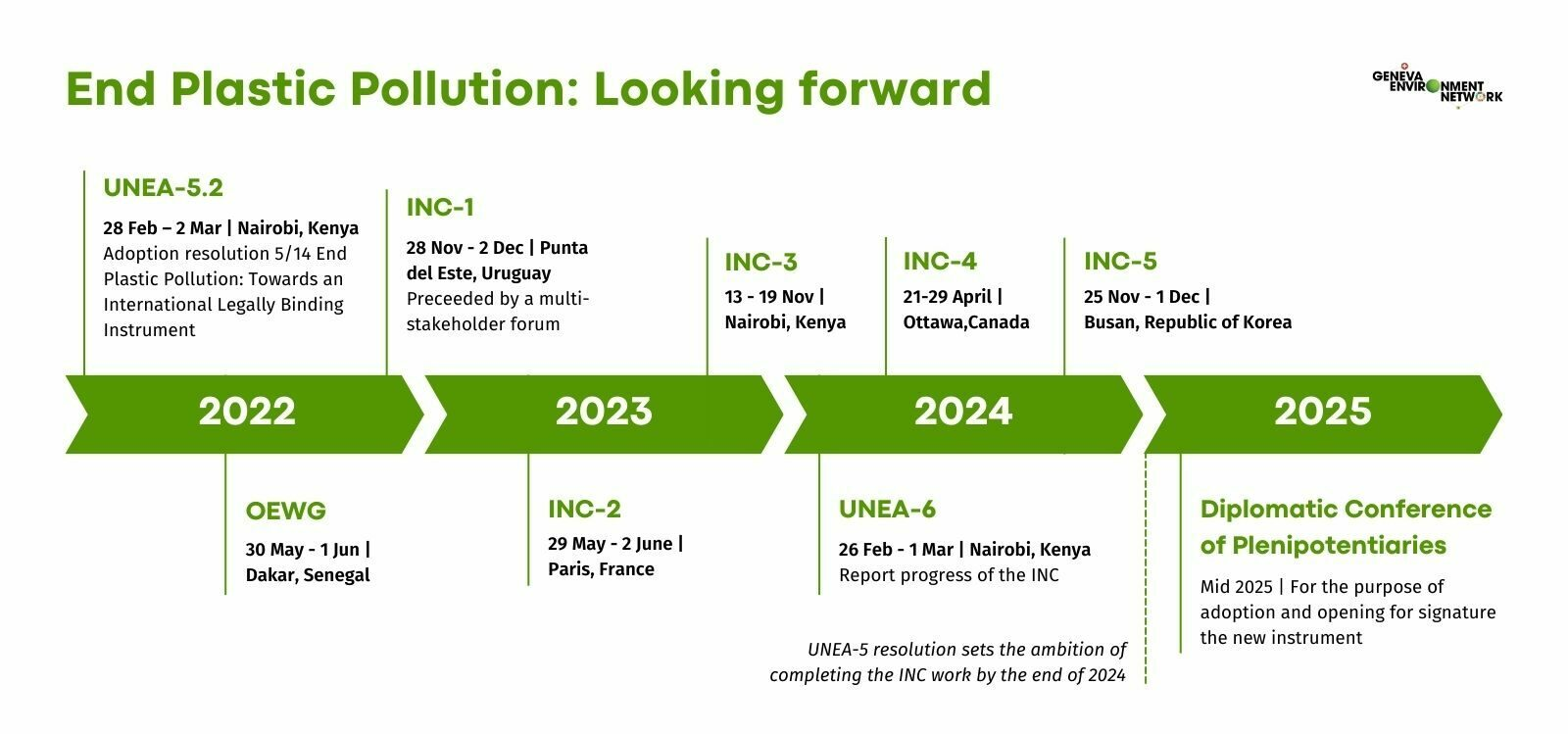
Five non-papers have been prepared by other sub-groups following INC-4 to establish an unbiased facts base to start off discussions for INC-5 negotiations. Held November 25th to December 1st in Busan, Korea, agenda items include establishing an open-ended legal drafting group to negotiate the proposed laws for satisfaction and compliance from all parties. These acts will work as a treaty between countries and a contract between a company and its corresponding government. The Center for International Environmental Law has prepared a comprehensive resource center to help you prepare for INC-5 and the reports prepared for the next session.
Mid-2025 is slated for the Diplomatic Conference of Plenipotentiaries (aka, a meeting of government ambassadors), will meet to motion for adopting and signing the new instrument developed during and following INC-5.
Federal Plastics Registry
During INC-4, Canada’s Minister of Environment and Climate Change, the Honourable Steven Guilbeault, announced the country’s accountability plan for managing plastic production and pollution, starting with their Federal Plastics Registry.
This will be an ongoing phase-in plan to compel not only plastic producers, but all companies spanning plastic’s value chain to help monitor and track a plastic’s lifecycle: from cradle to grave. By tracking its production to end of life, receiving reliable data will help inform further actions to reduce plastic waste and pollution to meet the 2040 zero-waste goal. Resin manufacturers, service providers, and producers of plastic products will be required to report annually on the quantity and types of plastic they manufacture, import, and place on the market. Producers and service providers will also be required to report on any materials diverted, reused, repaired, remanufactured, recycled, reprocessed, composted, incinerated, or landfilled.
The registry will not only help companies address the full lifecycle of their plastics to improve their bottom line, but it will also encourage individuals to develop a circular mindset to reflect and improve their personal consumption and waste production. Ultimately, a circular economy “keeps plastic in the economy and out of the environment”.
The registry’s data is invaluable to companies like Oligomaster that are developing advanced recycling techniques. They will be able to home in on Canada’s demand and volume required to recycle traditionally non-recyclable materials.
Canada Toward a Circular Economy
The Federal Plastic Registry comes as part of their commitment to developing a circular economy. Circular Economy Leadership Canada defines a circular economy as “a restorative system in which waste and pollution are eliminated and resource extraction is minimized through systemic design, maintaining and improving the value of products and components, and achieving a circular flow of resources, while regenerating natural ecosystems.”
Oligomaster believes in a circular economy beyond industry. Circularity may start with policy makers and industry leaders, but it ends with consumers making conscious choices what to buy. Canadian culture has a current mindset of a linear “take-make-waste" economy where single use is cheap and efficient. A circular economy challenges those habits and retain the highest value for the resources, products, and materials for as long as possible. A circular mindset means considering a product’s impact beyond its short useable. Consider how and by what means that product got into your hands and if it allows for renewability, optimal use, re-use, refurbishment, remanufacturing, recycling, and biodegradation once it’s one again out of your hands.
-
September 2025 will see Phase 1 of the Federal Plastic Registry’s introduction where companies will be required to report on the quantity of plastics imported, manufactured, and placed on the market in the packaging, electronics, and single-use/disposables industries from the 2024 calendar year.
-
Phase 2 will occur in 2026 with an expansion of the reporting requirements to all resin manufacturers and importers in all remaining categories (resins, agriculture and horticulture, tires, transportation, construction, fishing and aquaculture, and textiles and apparel). Packaging and plastic waste generated at industrial, commercial, and institutional facilities will also become mandatory to report.
-
Phase 3 in 2027 is currently slated to require reporting on plastics collected and sent for diversion and disposal for electronics, tires on top of packaging and single-use products. Beyond 2027 a full scope phase-in for all other categories will be implemented.
Remarks
Most of the time, climate news is presented as dire, and that all hope is lost. It is important to know that governments, organizations, companies, and people are actively trying to slow, and ultimately reverse humans’ current impact on the environment. Plastic pollution is not only being addressed at the policy level, but at the consumer level too.
Following a top-down approach, governments are offering subsidies to businesses and organizations to fund the research and development of more eco-friendly plastics and substitutes. These organizations then require self-sustaining income, so they sell the product to advance other endeavours. Selling the product requires marketing, getting it into a store, and having a consumer buy it.
Incurring any change in consumer habits seems to be a large undertaking. Thankfully, Oligomaster helps with every step in this process from sourcing and advising on grant applications to product development, to market launch! Oligomaster is a forward thinking start-up that provides resources to approach sustainable product development. We offer extensive knowledge and experience knows how to utilize govermnent grants for developing products, a decentralized lab facility to develop, manufacture, and test your product, and a team of experts to make your sustainable innovation a reality in the plastics and coatings market.
Change takes time, but Oligomaster makes it easier to make your product's goals achievable and effectively traslate bench-to-market innovations. As an innovator, entrepreneur, or even consumer, know that despite being only one individual, you are impacting markets, influencing policies, and driving change, ultimately leading to a more positive climate future.